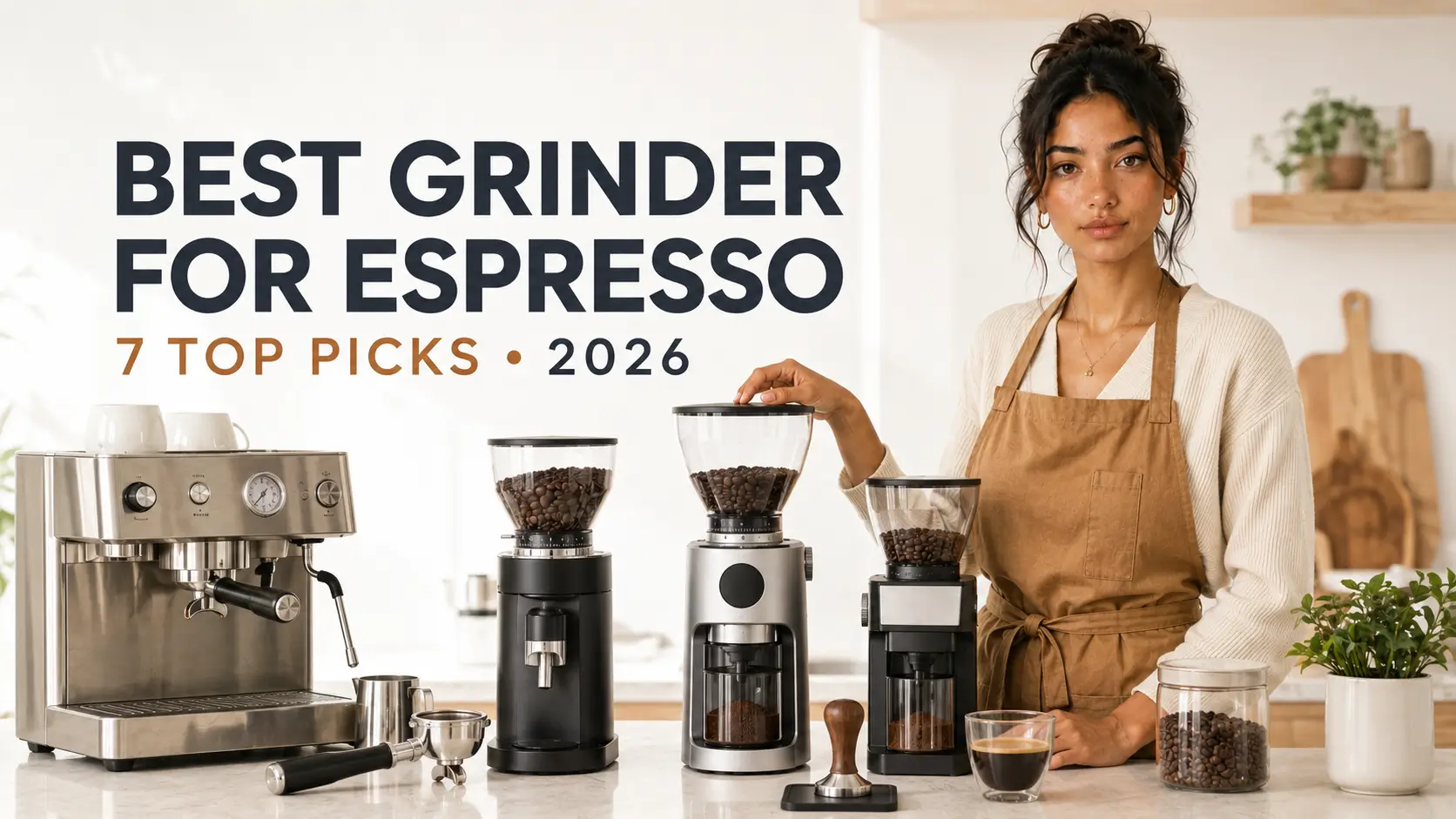
The best coffee grinder for espresso should make very small, repeatable grind changes and produce grounds fine enough to control shot flow. For most home users, the Baratza Encore ESP offers the strongest balance of espresso-focused adjustment, simple operation and easy-to-find replacement parts. Buyers who want timed dosing may prefer the Breville Smart Grinder Pro, while manual-grinder users get finer adjustment from the 1Zpresso J-Ultra.
This guide compares seven electric and manual burr grinders for different budgets and workflows. The recommendations are based on manufacturer specifications, manuals, adjustment design and intended use. Products were not personally tested unless explicitly stated.
| At a glance: Best overall electric — Baratza Encore ESP Best timed dosing — Breville Smart Grinder Pro Best compact single-dose electric — Fellow Opus Best beginner hopper grinder — De’Longhi Dedica KG521 Best-value manual — KINGrinder K6 Best premium manual — 1Zpresso J-Ultra Best travel-friendly manual — TIMEMORE Chestnut C3 ESP Pro |
What Makes a Coffee Grinder Good for Espresso?
An espresso grinder needs a fine grind range, narrow adjustment steps and repeatable settings. Espresso is sensitive to small changes: one adjustment can noticeably alter how quickly water passes through the coffee puck. A blade grinder cannot provide that control because it chops beans unevenly instead of passing them through a calibrated burr gap.
The most useful features are fine adjustment resolution, stable burr alignment, low retention and a workflow that fits your routine. A hopper-and-timer design is convenient for repeated drinks; a single-dose grinder is better when you weigh each dose or frequently change beans. Manual grinders can deliver excellent precision for less money, but they require physical effort.
How We Selected These Espresso Grinders
We began with U.S. keyword research around “best grinder for espresso,” then removed irrelevant searches, brand-only terms and topics already covered on HomeAndKitchenFind.com. Product selection was based on official manufacturer pages and manuals, with emphasis on espresso adjustment, burr design, dosing workflow, cleaning access and suitability for a typical home setup.
- No product is presented as personally tested.
- No live price, rating or review count is hard-coded because those details change.
- “Best” labels describe the use case that each design fits—not a laboratory performance ranking.
- Availability, accessories and warranty terms should be confirmed on the seller page before purchase.
Espresso Grinder Comparison
| Grinder | Type | Adjustment | Workflow | Best for |
| Baratza Encore ESP | Electric | 40 numbered settings; espresso-focused lower range | Dose cup / hopper | Best overall electric |
| Breville Smart Grinder Pro | Electric | 60 settings | Timed dosing / hopper | Convenient repeated drinks |
| Fellow Opus | Electric | 41+ settings with inner micro-adjustment | Single dose | Compact multi-brew setup |
| De’Longhi Dedica KG521 | Electric | 18 settings | Hopper / filter-holder support | Simple beginner workflow |
| KINGrinder K6 | Manual | External, 60 clicks per rotation; 16 μm per click | Single dose | Manual value |
| 1Zpresso J-Ultra | Manual | External, 8 μm per click | Single dose | Premium manual precision |
| TIMEMORE C3 ESP Pro | Manual | Espresso-oriented stepped dial | Single dose | Portable espresso setup |
1. Baratza Encore ESP — Best Overall Electric Espresso Grinder
| Why it stands out: The Encore ESP is the most balanced starting point for home espresso because its adjustment system gives extra resolution in the fine range without making everyday operation complicated. The included dosing cup also supports a clean transfer into common portafilters. |

40 mm M2 conical steel burr
40 numbered grind settings
Settings 1–20 provide finer espresso-oriented adjustment; 21–40 cover broader brew methods
Quick-release burr system for easier access
Includes dosing cup and grounds bin
Key specifications
- 40 mm M2 conical steel burr
- 40 numbered grind settings
- Settings 1–20 provide finer espresso-oriented adjustment; 21–40 cover broader brew methods
- Quick-release burr system for easier access
- Includes dosing cup and grounds bin
Advantages
- Straightforward hopper adjustment
- Fine-range control designed specifically for espresso
- Can also cover filter-coffee methods
- Baratza publishes manuals and replacement-part support
Limitations to know
- No built-in scale or programmable dose timer
- Hopper workflow is less ideal for frequent bean changes
- The start point still needs to be dialed in for each coffee and espresso machine
Best for: most home users who want a capable, uncomplicated electric espresso grinder.
2. Breville Smart Grinder Pro — Best for Timed Dosing
| Why it stands out: The Smart Grinder Pro suits households that make several drinks with the same beans. Its display, portafilter cradles and programmable timing reduce repeated measuring once a dose has been calibrated. |

Stainless-steel conical burrs
60 grind settings from espresso through French press
Dosing IQ timing adjustable in 0.2-second increments
LCD shows grind setting, time and selected shots or cups
Includes 50–54 mm and 58 mm portafilter cradles plus a sealed grounds container
Key specifications
- Stainless-steel conical burrs
- 60 grind settings from espresso through French press
- Dosing IQ timing adjustable in 0.2-second increments
- LCD shows grind setting, time and selected shots or cups
- Includes 50–54 mm and 58 mm portafilter cradles plus a sealed grounds container
Advantages
- Convenient direct-to-portafilter workflow
- Repeatable timed dosing after calibration
- Large control range for multiple brew methods
- Clear display is approachable for beginners
Limitations to know
- Timed output is not the same as weight-based dosing
- A full hopper is less convenient when changing beans often
- More controls and parts to clean than a simple single-dose grinder
Best for: espresso drinkers who prioritize speed, a display and repeatable timed doses.
3. Fellow Opus — Best Compact Single-Dose Electric Grinder
| Why it stands out: The original Fellow Opus combines a small footprint with an espresso-to-cold-brew range. Its outer dial is simple, while the inner ring adds finer adjustment when the main steps do not land exactly where a shot needs them. |

40 mm six-blade stainless-steel conical burrs
41+ settings across the main and inner adjustment system
Single-dose load bin
Anti-static design and magnetic catch cup
Timed auto-stop controlled by the power button
Advantages
- Compact and visually clean on a small counter
- Useful for people who weigh beans before grinding
- Covers espresso and coarser brew methods
- Inner ring adds extra dialing flexibility
Limitations to know
- The two-part adjustment system has a learning curve
- Mostly plastic housing
- Confirm that the seller listing is the original Opus, not the newer Opus 2
Best for: small kitchens and users who want one compact single-dose grinder for espresso and filter coffee.
4. De’Longhi Dedica KG521 — Best Beginner Hopper Grinder
| Why it stands out: The Dedica KG521 offers a familiar hopper, an LCD and direct grinding into a supported filter holder. Its controls are easier to understand than a specialist stepless grinder, making it a practical entry-level match for many pressurized-basket machines. |
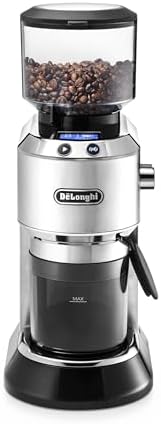
Stainless-steel conical burr mechanism
18 adjustable grind levels
LCD interface
Cup selector for 1–14 cups
350 g bean hopper and filter-holder support
Advantages
- Simple visual controls
- Can grind into a filter holder or grounds container
- Large hopper for repeated household use
- Removable upper burr supports routine cleaning
Limitations to know
- Eighteen settings provide less fine control than espresso-specialist grinders
- May be harder to dial in with demanding unpressurized baskets
- The large hopper is not intended for frequent single-dose bean changes
Best for: beginners who value a display and convenient hopper workflow, especially with a compatible De’Longhi setup.
5. KINGrinder K6 — Best-Value Manual Grinder
| Why it stands out: The K6 gives budget-conscious buyers external adjustment and a substantial stainless-steel burr without paying for an electric motor. Its 16-micron steps are fine enough to make controlled espresso changes while remaining versatile for other methods. |

48 mm heptagonal stainless-steel burr
External adjustment
60 clicks per rotation
16 μm movement per click
Approximately 30–35 g hopper capacity
Advantages
- Strong specification-to-cost value
- External dial is easier to track than an internal adjustment nut
- Suitable for espresso and broader brew methods
- No motor noise and no countertop power requirement
Limitations to know
- Hand-grinding espresso-fine coffee takes effort
- Not ideal for serving several drinks back to back
- Setting references are starting points, not universal recipes
Best for: buyers who want fine manual control at a lower cost and usually prepare one or two shots.
6. 1Zpresso J-Ultra — Best Premium Manual Espresso Grinder
| Why it stands out: The J-Ultra is built around espresso precision. Its 8-micron external steps allow smaller grind changes than the other manual grinders in this list, and its coated 48 mm burr is specifically positioned for espresso. |

48 mm coated espresso burr
External adjustment ring
8 μm burr movement per click
35–40 g grounds capacity
Magnetic catch cup and tool-free disassembly
Advantages
- Very fine adjustment resolution
- Fast, espresso-focused burr design
- External dial makes changes easy to record
- Premium single-dose workflow without an electric motor
Limitations to know
- Higher purchase cost than entry-level hand grinders
- Still requires effort for fine espresso grinding
- Magnetic catch cup should be handled carefully during transfer
Best for: espresso enthusiasts who want high adjustment precision and do not mind hand grinding.
7. TIMEMORE Chestnut C3 ESP Pro — Best for Travel
| Why it stands out: The C3 ESP Pro adapts TIMEMORE’s compact C-series body for finer espresso adjustment and adds a folding handle. It is the easiest grinder here to pack for a travel espresso setup while still offering a purpose-built espresso dial. |

Manual conical-burr grinder in the C3 series
Espresso-oriented finer-click adjustment
Pull-to-fold handle
Aluminum-alloy body and crank arm
Threaded catch cup and silicone base
Advantages
- Compact, portable construction
- Folding handle reduces storage space
- Finer dial than the standard C3 models
- Threaded cup is secure during travel
Limitations to know
- Smaller body can be less comfortable for large or repeated doses
- Manual grinding takes time
- Verify that the Amazon listing says “C3 ESP Pro”; standard C3 versions use a different adjustment system
Best for: travelers, occasional espresso drinkers and small kitchens that need a compact hand grinder.
How to Choose the Best Espresso Grinder for Your Setup
Adjustment resolution
Espresso needs small changes. A grinder with many meaningful fine-range steps—or a stepless mechanism—makes it easier to correct a shot that runs slightly too fast or too slow. A high total setting count is useful only if enough of those settings fall inside the espresso range.
Burr design and alignment
Burrs crush coffee between controlled surfaces, producing a more consistent distribution than blades. Burr diameter and shape affect speed and workflow, but alignment and adjustment stability matter just as much. Conical burrs dominate this price range and can work well for espresso when paired with a fine adjustment system.
Stepped vs. stepless adjustment
Stepped grinders are easy to record and return to. Stepless grinders allow nearly continuous adjustment but can be harder to reproduce exactly. For a first home setup, closely spaced steps are usually the simpler choice.
Hopper, timed dosing or single dosing
A hopper and timer are convenient when the same beans are used every day. Single dosing means weighing one dose of beans, grinding it and clearing the chamber; it works better for switching coffees and monitoring input and output weights. Neither workflow is automatically superior—the right choice depends on speed, freshness habits and how often beans change.
Retention and static
Retention is coffee that remains inside the grinder after a dose. It can make the next dose less predictable, especially when changing beans or grind settings. Chute design, bellows, anti-static features and regular brushing can reduce mess, but no home grinder should be assumed to have literally zero retention.
Manual vs. electric
A manual grinder directs more of the budget toward burrs and adjustment, but fine espresso grinding requires effort. Electric grinders are faster and better for multiple drinks. Choose manual for value and portability; choose electric for convenience and higher daily volume.
How to Dial In an Espresso Grinder
There is no universal espresso setting. Bean density, roast date, basket, dose, machine pressure and humidity can all change the correct grind. Treat the manufacturer’s range as a starting point, then adjust using measured results.
- Use the machine and grinder manuals to choose a safe starting setting in the espresso range.
- Weigh the coffee dose before brewing and keep it consistent while dialing in.
- Choose a target beverage yield appropriate for your recipe, then measure the actual output by weight.
- If the shot flows much too quickly, grind finer. If it chokes or runs much too slowly, grind coarser.
- Change only one variable at a time, using one small grinder step between attempts.
- Once the flow and taste are balanced, record the bean, dose, setting and yield. Recheck as the coffee ages.
Frequently Asked Questions
A burr grinder is strongly recommended because it creates a controlled, repeatable grind. Blade grinders produce mixed particle sizes and do not offer a calibrated espresso adjustment.
Only if its manufacturer specifies an espresso-capable fine range and the adjustment steps are small enough to control shot flow. Many general-purpose grinders can grind finely, but their steps may be too wide for dialing in an unpressurized basket.
Manual grinders often provide excellent precision for the money and suit one or two drinks. Electric grinders are faster and more convenient for repeated shots. The better choice depends on budget, effort and daily volume.
They need stable burr alignment, a motor or crank system that can handle very fine coffee, and an adjustment mechanism capable of small repeatable changes. Those requirements are more demanding than coarse filter grinding.
Neither shape guarantees better espresso. Burr geometry, alignment, motor stability and the adjustment mechanism have a larger practical effect. Conical burrs are common and effective in affordable home grinders; flat burrs are common in larger specialist models.
Single dosing means weighing only the beans needed for one preparation, grinding them and clearing the chamber before the next dose. It helps users switch coffees and track dose weight.
Brush accessible dry coffee residue regularly and follow the manufacturer’s cleaning schedule. Never wash burrs or internal electrical parts unless the manual explicitly permits it. Oils and fine particles may require more frequent cleaning with dark roasts.
Some grinders cover both ranges, including several in this guide. Switching far across the dial can retain a little coffee and may require purging or re-dialing. For French-press-specific choices, see our dedicated grinder guide.
Related Coffee Guides
Coffee grinders for French press: https://homeandkitchenfind.com/best-coffee-grinders-for-french-press/
At-home coffee machines: https://homeandkitchenfind.com/best-at-home-coffee-machine/
Coffee makers: https://homeandkitchenfind.com/best-coffee-makers/
Pour-over coffee makers: https://homeandkitchenfind.com/best-pour-over-coffee-makers/
How to clean a coffee maker: https://homeandkitchenfind.com/how-to-clean-a-coffee-maker/
Final Recommendation
For most home espresso drinkers, start with the Baratza Encore ESP because its fine-range adjustment and simple dosing workflow are designed around espresso without limiting other brew methods. Choose the Breville Smart Grinder Pro when programmable timed dosing matters more than single-dose simplicity. For manual grinding, the KINGrinder K6 offers the strongest value, while the 1Zpresso J-Ultra is the precision-focused upgrade.
Whichever grinder you choose, confirm the exact model, voltage, included accessories and return policy on the seller page. A capable grinder is only the starting point: fresh beans, a consistent dose and one-variable-at-a-time adjustments are what turn it into repeatable espresso.