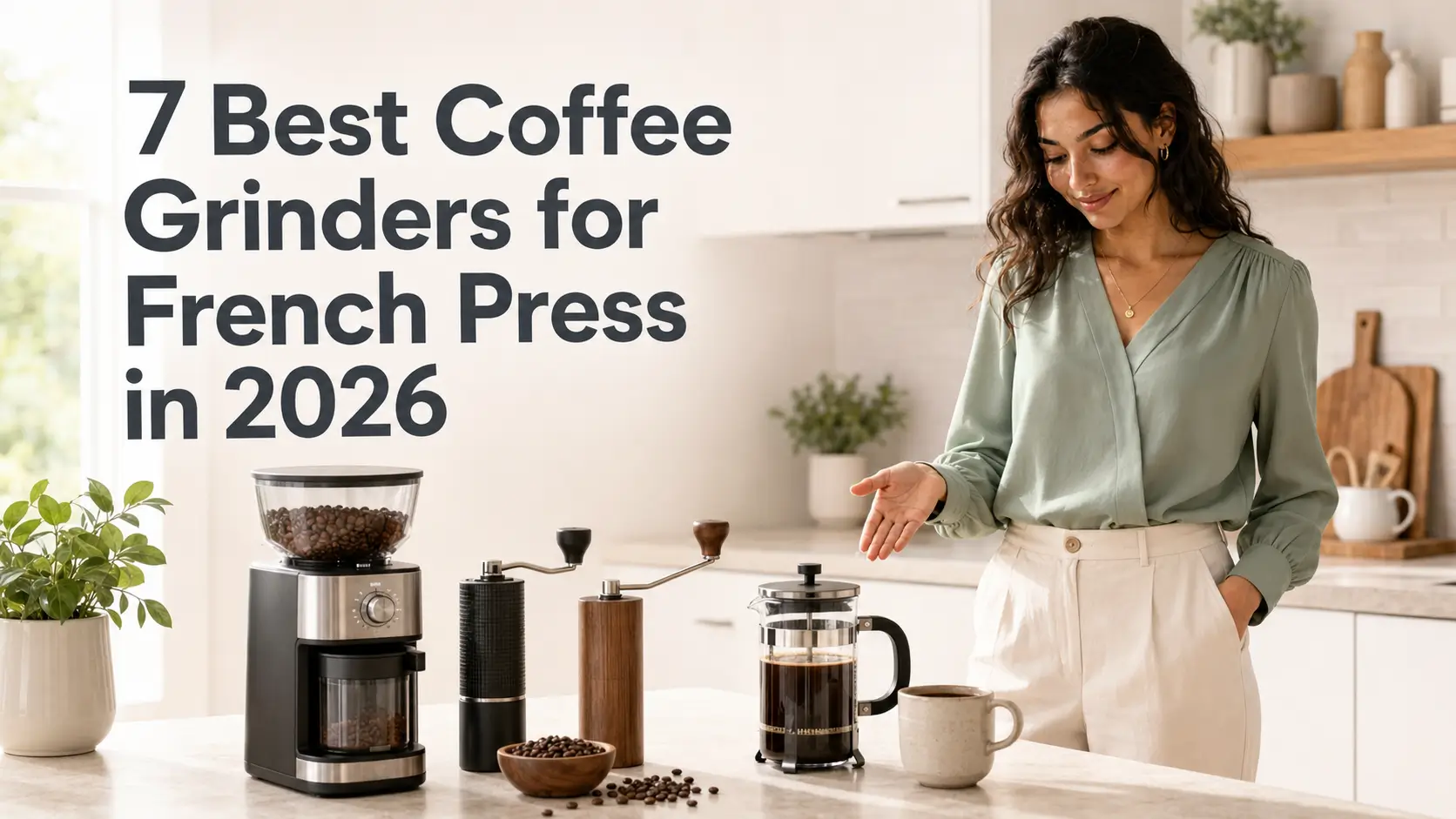
The best coffee grinder for French press should produce coarse particles with as few powdery fines as possible. Those fines slip through the mesh filter, continue extracting in the carafe and can make the final cup muddy or bitter. For most households, the Baratza Encore is the strongest all-around electric choice because its simple controls, 40-step adjustment system and serviceable design suit repeated daily brewing. Manual-grinder shoppers should consider the KINGrinder K6 for its precise external adjustment and efficient stainless-steel burr.
This research-based guide compares seven burr grinders across coarse-grind control, capacity, workflow, cleaning and versatility. We reviewed current manufacturer pages and manuals; we did not personally test these products. Availability and specifications can change, so confirm the exact model in the retailer listing before buying.
| Best overall electric: Baratza Encore Best easy-to-use electric: OXO Brew Conical Burr Grinder Best quieter electric: Capresso Infinity Plus Best overall manual: KINGrinder K6 Best compact manual: TIMEMORE Chestnut C3S Pro Best higher-capacity manual: 1Zpresso J Best budget/travel manual: JavaPresse Manual Burr Grinder |
Why does French press coffee need a coarse, consistent grind?
French press coffee normally works best with a coarse, even grind because the grounds remain immersed in water for several minutes and are separated by a metal mesh rather than a paper filter. Uneven grinding creates both large pieces that extract slowly and tiny fines that extract quickly. The result can taste weak and bitter at the same time.
| Start with a texture similar to coarse sea salt. If the brew tastes sharp or thin, grind slightly finer. If it tastes harsh, bitter or silty, grind coarser. The best setting depends on the beans, dose, steep time and the calibration of your grinder. |
How we selected these French press grinders
We prioritized features that materially affect immersion brewing rather than chasing the largest number of settings. Our selection criteria were:
- Burr design and the ability to reach a repeatable coarse range
- Adjustment clarity and enough separation between coarse settings
- Practical bean or grounds capacity for common French press batches
- Workflow, noise, static, cleaning and counter-space requirements
- Versatility for households that also brew pour-over or drip coffee
- Current manufacturer documentation and likely Amazon availability
A high setting count does not automatically mean a grinder is better. Burr alignment, particle distribution and a usable adjustment range matter more than the headline number.
Best coffee grinders for French press: comparison
| Grinder | Type | Adjustment / capacity | Best for | Main limitation |
| Baratza Encore | Electric | 40 settings; 40 mm conical burrs | Best overall electric | Larger footprint than hand grinders |
| OXO Brew Conical Burr | Electric | 15 settings + microsettings; 12 oz hopper | Simple daily use | Grounds container can collect static |
| Capresso Infinity Plus | Electric | 16 settings; 1–12 cup timer | Lower-noise workflow | Fewer fine adjustment steps |
| KINGrinder K6 | Manual | External adjustment; 25–30 g | Best overall manual | Hand grinding takes effort |
| TIMEMORE C3S Pro | Manual | 38 mm burr; foldable handle | Compact storage and travel | Smaller batches may need two loads |
| 1Zpresso J | Manual | Internal adjustment; 30–35 g | Larger manual batches | Internal dial is less convenient |
| JavaPresse Manual | Manual | 18 settings; ceramic burr | Budget and travel | Slower and less uniform than premium manuals |
The 7 best coffee grinders for French press
1. Baratza Encore — Best overall electric grinder
The Baratza Encore is the most balanced choice for people who want an uncomplicated electric grinder for French press, drip and pour-over coffee. Its 40 individual settings provide a broad adjustment range, while the 40 mm conical burrs are designed for consistent filter-coffee grinding. The hopper itself rotates to select the grind, so switching back to a saved setting is straightforward.

40 individual grind settings;
precision-machined 40 mm conical burrs;
front pulse button and on/off switch.
Advantages
- Wide, repeatable range for coarse through filter brewing
- Simple controls suit everyday use
- Replaceable parts and manufacturer support improve long-term serviceability
Limitations to know
- It costs more than entry-level grinders
- It is not the smallest option for a crowded counter
- Retained grounds mean occasional cleaning is still necessary
Best for: Households that brew French press often and want one dependable electric grinder for several filter methods.
2. OXO Brew Conical Burr Coffee Grinder — Best for easy daily use
The OXO Brew is a friendly step up from a blade grinder. It has 15 numbered settings plus intermediate microsettings, and OXO identifies settings 11 through 15 as the coarse range for methods such as French press. Its 12-ounce UV-blocking hopper is useful when several people drink coffee, while the one-touch timer remembers the previous setting.

15 settings plus microsettings;
Stainless-steel conical burrs;
12 oz UV-blocking hopper;
One-touch timer.
Advantages
- Clear controls and a useful coarse range
- Large hopper suits repeated household brewing
- Timer reduces daily guesswork
Limitations to know
- Static can leave grounds around the catch cup
- The timer doses by time rather than weight
- Its footprint is larger than a manual grinder
Best for: Shoppers who value convenience, a larger hopper and an intuitive electric workflow.
3. Capresso Infinity Plus — Best quieter electric option
The Capresso Infinity Plus uses a gear-reduction motor intended to grind slowly with less heat, friction and noise than many high-speed grinders. Its 16 marked settings are grouped into extra-fine, fine, regular and coarse ranges. A 1-to-12 cup selector and pulse option make it easy to handle both measured batches and small top-ups.

16 marked settings;
Commercial-grade conical steel burrs;
Gear-reduction motor;
1–12 cup selector and pulse.
Advantages
- Coarse range is clearly labeled
- Slower motor design reduces noise and heat
- Compact upright form works on many counters
Limitations to know
- Only 16 settings, so changes are broader than on premium grinders
- The cup timer is an estimate, not a scale
- The plastic grounds bin may hold static
Best for: People who want an electric burr grinder with a calmer sound profile and uncomplicated controls.
4. KINGrinder K6 — Best overall manual grinder
Research verdict: The KINGrinder K6 is a capable manual option for drinkers who want fine control without paying for a high-end electric grinder. Its exterior adjustment is faster to use than a dial hidden below the burr, and the manufacturer lists 60 clicks per rotation with 16-micron movement per click. The heptagonal stainless-steel burr is designed for efficient, versatile grinding.

Exterior adjustment
60 clicks per rotation
16 μm per click
Heptagonal stainless-steel burr
Approximately 25–30 g capacity
Advantages
- Convenient external dial makes settings easy to repeat
- Efficient burr handles coarse doses better than many budget hand grinders
- Broad range also supports pour-over and other methods
Limitations to know
- A large French press may require more than one batch
- Manual grinding requires time and grip strength
- Heavier than minimalist travel grinders
Best for: Coffee enthusiasts who prefer manual grinding but still want fast adjustment and strong all-method versatility.
5. TIMEMORE Chestnut C3S Pro — Best compact manual grinder
The TIMEMORE Chestnut C3S Pro combines a compact metal body with a foldable handle, which helps it fit into a drawer or travel kit. The C3 series uses a 38 mm CNC-machined burr and a click-based internal adjustment. It is a better match for one or two servings than for repeatedly grinding a very large carafe.

38 mm CNC-machined burr
Click adjustment; metal body
Foldable handle on the Pro version
Advantages
- Compact handle and body store neatly
- Fast burr geometry is a clear upgrade from basic ceramic hand grinders
- Useful across French press, drip and pour-over ranges
Limitations to know
- Internal adjustment requires removing the catch cup
- Capacity is better suited to smaller batches
- Confirm the Pro model because C3 variants differ
Best for: Apartment kitchens, travel and smaller French press batches where compact storage matters.
6. 1Zpresso J — Best higher-capacity manual grinder
The 1Zpresso J is a substantial hand grinder with a manufacturer-listed grounds capacity of about 30 to 35 grams. Its internal adjustment uses 30 clicks per rotation, and the metal construction gives it a sturdy feel. The larger capacity is helpful for a medium French press, although the internal dial is slower to access than an external ring.

Internal adjustment
30 clicks per rotation
0.025 mm per click
Approximately 30–35 g grounds capacity
Advantages
- Larger capacity than many compact hand grinders
- Solid construction and efficient grinding
- Repeatable click system with an official grind chart
Limitations to know
- Adjustment dial is inside the catch-cup area
- Heavier and less packable than slim travel models
- May still require two loads for very large brews
Best for: People who want a durable manual grinder and often prepare medium-size French press batches.
7. JavaPresse Manual Burr Grinder — Best budget and travel choice
The JavaPresse manual grinder is a lower-cost way to move from a blade grinder to an adjustable burr design. It offers 18 settings and the company recommends the coarse 13-to-18-click range for French press and cold brew. Its slim, power-free design travels easily, but the ceramic burr is slower and can produce more fines than premium steel-burr models.

18 grind settings
Ceramic conical burr
Hand-crank operation
Slim travel-friendly body
Advantages
- Accessible price for first-time burr-grinder buyers
- Quiet and usable without electricity
- Manufacturer provides clear French press starting settings
Limitations to know
- Slower than larger steel-burr hand grinders
- Particle consistency is less refined than premium choices
- A large batch can feel laborious
Best for: Occasional French press users, campers and budget shoppers who prioritize portability.
How to choose a coffee grinder for French press
Choose burrs instead of blades
A blade grinder chops beans for as long as the motor runs, so one batch can contain powder and large fragments. A burr grinder passes beans through a controlled gap, which makes the result easier to repeat. For French press, that repeatability reduces fines and helps the whole batch extract more evenly.
Decide between electric and manual
Choose electric if speed, larger batches and repeatable morning use matter most. Choose manual if you value lower noise, portability and better burr quality at a given budget. Manual grinding is practical for one or two cups; it becomes less attractive when you regularly grind 50 grams or more.
Match capacity to your normal batch
Check how many grams of coffee you normally use, not only the number of “cups” printed on a brewer. A 20-gram hand grinder may need two or three loads for a large French press. Hopper capacity matters less if you weigh each dose and keep beans in an airtight container.
Look for usable coarse adjustment
You do not need hundreds of steps for French press, but you do need several usable positions in the coarse range. The goal is to make small taste corrections without jumping from silty to under-extracted. Clear markings also help you return to a setting after grinding for another brewer.
Consider cleaning, static and retention
Coffee oils and trapped grounds become stale. Look for accessible burrs, a supplied brush and a catch cup that is easy to wipe. Electric grinders can retain a small amount of coffee and may produce static; a light tap after grinding and regular dry brushing usually help. Follow the manufacturer’s cleaning instructions and do not wash burrs unless the manual explicitly allows it.
How should you grind coffee for French press?
- Measure the beans for your normal recipe before grinding.
- Set the grinder to a coarse starting point recommended by its manufacturer.
- Grind immediately before brewing and inspect the grounds for excessive powder.
- Brew with your usual dose, water temperature and steep time so grind size is the only changing variable.
- If the coffee is sour, thin or hollow, move one step finer. If it is bitter, dry or silty, move one step coarser.
- Record the setting that works for each bean; roast level and age can change the best position.
| There is no universal French press number because grinder calibrations differ. Use a coarse starting setting, keep the recipe constant and adjust by taste one step at a time. |
If you also brew filter coffee, see our best pour-over coffee makers guide. For water-control options, compare our best electric kettles and our explanation of gooseneck kettles versus regular kettles.
Frequently asked questions
Start coarse, with particles that resemble coarse sea salt. Adjust slightly finer if the cup is thin and slightly coarser if it is bitter or silty. Manufacturer setting numbers are not interchangeable between grinders.
Yes. A burr grinder provides more uniform and repeatable particles than a blade grinder. That helps control extraction and usually reduces the powdery fines that pass through a French press filter.
Neither type is universally better. Electric grinders are faster and easier for large batches. Manual grinders are quieter, portable and can offer excellent burr quality for the price, but they require more time and effort.
Only if its adjustment range extends far enough into coarse settings. Some espresso-focused grinders are optimized for very fine changes and may not produce a clean coarse grind. Check the manufacturer’s recommended brew range.
A small amount is normal because the metal filter allows oils and very fine particles through. Excess sludge usually comes from too many fines, a setting that is too fine, aggressive plunging or pouring the last sediment from the carafe.
Brush loose grounds regularly and perform the deeper cleaning schedule in the manual. Frequency depends on use and bean oiliness. Never put a grinder or its burrs in water unless the manufacturer explicitly says the parts are washable.
Yes, if it has a broad filter-coffee range and repeatable markings. Save the preferred setting for each method and purge or tap out retained grounds when switching.
Choose a grinder that can hold your normal coffee dose. Around 25 to 35 grams suits many small or medium batches; a large French press may require a bigger electric hopper or multiple manual loads.
Final recommendation
For most households, the Baratza Encore is the best coffee grinder for French press because it combines a practical coarse range, uncomplicated controls and long-term parts support. Choose the OXO Brew if a large hopper and one-touch timer matter more, or the Capresso Infinity Plus if you prefer a slower, quieter electric workflow. Among manual options, the KINGrinder K6 offers the strongest combination of adjustment convenience and grinding efficiency, while the JavaPresse is the more accessible travel choice.
Whichever grinder you choose, consistency matters more than chasing one “perfect” number. Begin coarse, keep the rest of the brew recipe stable and adjust one step at a time.