A gooseneck kettle gives you a slower, more controlled stream for pour-over coffee. A regular kettle pours faster, usually holds more water and is more convenient for tea, French press, instant meals and general kitchen use. The better choice depends on how often you make pour-over coffee and whether control matters more than speed and capacity.
For this comparison, we reviewed current manufacturer specifications, manuals and intended-use information. We compared spout design, flow control, heating power, usable capacity, temperature features, cleaning and everyday versatility. Products were not personally tested unless explicitly stated, and temporary prices, ratings and review counts were not used as evidence.
| Choose a gooseneck kettle if pour-over coffee is a regular part of your routine and you want to control where and how quickly water reaches the coffee bed. Choose a regular kettle if you mainly make tea, French press, oatmeal or several mugs at once. If you only make pour-over occasionally, a careful regular-kettle pour can still work. |
Gooseneck kettle vs regular kettle at a glance
| Feature | Gooseneck kettle | Regular kettle |
| Pouring style | Slow, narrow and controlled | Fast and direct |
| Best use | Pour-over coffee and precise small pours | Tea, French press, instant foods and general boiling |
| Typical capacity | Often about 0.8-1.0 L | Often about 1.5-1.7 L |
| Flow control | Excellent | Basic to moderate |
| Serving speed | Slower | Faster |
| Cleaning access | Narrow spout needs extra attention | Usually easier, especially with a wide lid |
| Counter value | Specialized | More versatile |
Capacity and features vary by model, so verify the exact listing rather than treating these ranges as universal.
What is a gooseneck kettle?
A gooseneck kettle has a long, curved and narrow spout. The restricted outlet slows the water and helps the user aim the stream. That control is useful in manual coffee brewing because pour-over recipes often require a small bloom pour followed by measured pulses or circular pours.
The spout does not automatically make better coffee. Grind consistency, coffee-to-water ratio, water temperature and recipe still matter. The kettle mainly makes controlled pouring easier and more repeatable.
Main advantages of a gooseneck kettle
- Better control over flow rate and placement.
- Easier starting and stopping during pulse-pour recipes.
- Reduced chance of flooding a small dripper with a sudden stream.
- Many electric models include temperature control and a brew timer.
- Balanced handles can improve stability during slow circular pours.
Limitations of a gooseneck kettle
- Slow pouring becomes inconvenient when filling pans or serving several cups.
- Many models have less capacity than standard electric kettles.
- The narrow spout can collect mineral deposits and is harder to inspect.
- Premium models cost more even though the kettle still performs the basic job of heating water.
What is a regular kettle?
A regular kettle uses a short, wider spout designed to move hot water quickly. Electric versions commonly offer larger capacities, wider lid openings and higher-power heating bases. Stovetop versions may be even simpler, but they do not provide automatic temperature control unless you use a separate thermometer.
A regular kettle is the more flexible household tool. It can fill mugs, a French press, a teapot, oatmeal bowls and cookware faster than a gooseneck. Its weakness appears when a small dripper needs a slow and precisely placed stream.
Main advantages of a regular kettle
- Faster pouring for several cups and general kitchen tasks.
- Larger capacities are common.
- Wide openings generally make filling and descaling easier.
- A wider range of basic and budget models is available.
- Temperature-control versions still support tea and French press brewing.
Limitations of a regular kettle
- The stream can surge when the kettle is tilted too far.
- Flow placement is less precise over a pour-over coffee bed.
- Large full kettles are heavier to lift.
- Basic boil-only models do not optimize temperatures for different drinks.
The key differences in daily use
Pour control
This is the decisive difference. A gooseneck naturally restricts the stream, so small changes in wrist angle produce gradual changes in flow. A regular spout releases more water and requires a gentler tilt to avoid pouring too fast.
Heating speed
Spout shape alone does not determine heating speed; wattage, starting water temperature and fill volume do. However, regular electric kettles often use 1500-watt bases and are easier to find in larger-capacity designs. Many goosenecks use 1000 to 1200 watts.
Capacity
Compact goosenecks commonly suit one or two manual brews. Regular 1.5- to 1.7-liter kettles better serve families, large teapots or repeated cups. Do not buy a larger kettle than you need, because heating excess water wastes time and energy.
Temperature control
Both designs can include presets or adjustable temperature. Precision is a model feature, not a benefit exclusive to goosenecks. Coffee enthusiasts may value one-degree adjustment, while most tea drinkers can use clearly labeled presets.
Versatility
Regular kettles win for all-purpose use. A gooseneck can still make tea and instant foods, but its slower stream is unnecessary for those tasks. A regular kettle can make pour-over coffee, but it requires more patience and technique.
Cleaning
Descale either kettle according to its manual. Wide lids improve interior access, while narrow gooseneck spouts may need repeated rinsing. Never immerse an electric kettle or base in water.
Price and value
Pay for a gooseneck when its flow control will be used regularly. For households that rarely make pour-over, a temperature-controlled regular kettle usually provides better everyday value.
Which kettle is better for different drinks?
| Drink or task | Better design | Why |
| Pour-over coffee | Gooseneck | Controlled flow and accurate placement |
| Tea | Regular | Faster serving and larger capacity |
| French press | Regular | No precision stream is required |
| AeroPress | Either | The brewer does not require a circular pour |
| Instant coffee or cocoa | Regular | Speed and capacity matter more |
| Oatmeal or instant noodles | Regular | Fast general-purpose pouring |
If pour-over is your main method, compare brewer styles in our best pour-over coffee makers guide. For an all-purpose buying list, see our best electric kettles guide.
Recommended kettles for each design
These examples are included to show how the two designs differ in real products. We verified the specifications against current manufacturer pages. Confirm the exact model and listing before inserting each Amazon block.
1. COSORI Original Electric Gooseneck Kettle – Best value gooseneck
Research verdict: A practical entry point for pour-over drinkers who want a controlled spout and simple temperature presets without paying premium-kettle prices.
COSORI gives this 0.8-liter model five labeled presets for white tea, green tea, oolong, coffee and boiling. Its 1200-watt base, stainless-steel kettle body and 60-minute hold function make it a straightforward choice for one or two drinks at a time.

5 𝑶𝑵𝑬-𝑻𝑶𝑼𝑪𝑯 𝑷𝑹𝑬𝑺𝑬𝑻𝑺
1-𝑯𝑶𝑼𝑹 𝑲𝑬𝑬𝑷 𝑾𝑨𝑹𝑴
𝑬𝑹𝑮𝑶𝑵𝑶𝑴𝑰𝑪 𝑫𝑬𝑺𝑰𝑮𝑵
𝑻𝑯𝑬 𝑷𝑼𝑹𝑬𝑺𝑻 𝑻𝑨𝑺𝑻𝑬
𝑷𝑹𝑬𝑪𝑰𝑺𝑬 𝑷𝑶𝑼𝑹𝑰𝑵𝑮
𝑻𝑼𝑹𝑵𝑰𝑵𝑮 𝑶𝑭𝑭 𝑻𝑯𝑬 𝑹𝑬𝑨𝑫𝒀 𝑻𝑶𝑵𝑬
Key specifications
- Type: electric gooseneck
- Capacity: 0.8 L / 0.85 qt
- Power: 1200 W
- Five presets: 170, 180, 195, 205 and 212 degrees F
- Temperature hold: up to 60 minutes
Advantages
- Preset temperatures remove guesswork for common drinks
- Narrow spout supports slower, more deliberate pouring
- Stainless-steel kettle, lid and spout
- Compact capacity suits small pour-over batches
Limitations to know
- Preset control is less flexible than one-degree adjustment
- Capacity is modest for families or several large mugs
- A slow gooseneck pour is inefficient for filling cookware
Best for: Budget-conscious pour-over beginners and tea drinkers who want simple presets.
2. Fellow Stagg EKG Pro – Best premium gooseneck
Research verdict: The strongest fit for dedicated pour-over users who value fine temperature control, a balanced precision spout and advanced scheduling and hold features.
The Stagg EKG Pro combines a 0.9-liter stainless-steel kettle with a temperature range of 104 to 212 degrees F. Its interface includes Guide Mode, a brew stopwatch, altitude adjustment, scheduling and adjustable 15- to 60-minute hold settings.

THE ULTIMATE POUR-OVER KETTLE
TAILORED TO YOUR ROUTINE
POUR LIKE A PRO
EFFORTLESS PRECISION
Key specifications
- Type: premium electric gooseneck
- Capacity: 0.9 L / 30 oz
- Power: 1000-1200 W, depending on configuration
- Temperature range: 104-212 degrees F
- Body material: 304 18/8 stainless steel
Advantages
- To-the-degree temperature selection
- Controlled spout and balanced handle for pour-over routines
- Built-in timer, scheduling and adjustable hold duration
- Guide Mode provides starting temperatures for coffee and tea
Limitations to know
- Premium price is difficult to justify for basic boiling
- Capacity is smaller than most regular electric kettles
- The updater app provides firmware updates, not remote kettle control
Best for: Enthusiasts who regularly brew pour-over coffee and will use precision features.
3. COSORI 1.7L Stainless Steel Kettle with Precision Control – Best versatile regular kettle
Research verdict: A useful middle ground for households that want a faster, larger regular-spout kettle while keeping adjustable temperature control for tea and coffee.
This 1500-watt regular kettle provides five one-touch drink presets plus adjustable temperature control from 105 to 212 degrees F in 5-degree increments. Its 1.7-liter body is much better suited to several mugs, French press, instant meals and general kitchen use than a compact gooseneck.
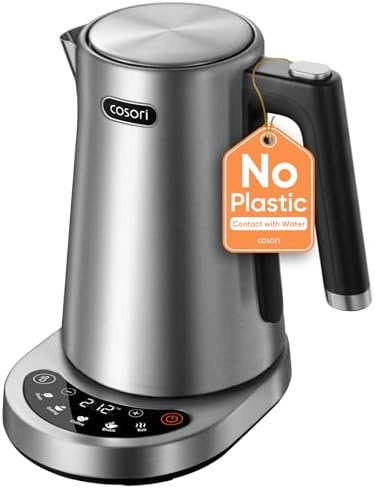
Fast Boiling & Custom Brewing
Plastic-Free Design
2 Lid Opening Angles
Built-In Water Level
Switch Temperature Units and Mute
Key specifications
- Type: regular-spout electric kettle
- Capacity: 1.7 L
- Power: 1500 W
- Temperature range: 105-212 degrees F in 5-degree increments
- Five presets plus boil, unit switching and mute control
Advantages
- Larger capacity and faster pouring than a gooseneck
- Adjustable temperature supports tea and coffee
- All-metal interior keeps plastic away from the water
- Wide lid opening improves filling and cleaning
Limitations to know
- Regular spout does not provide the same flow control for pour-over
- Larger footprint and full-kettle weight
- Internal markings are less visible than an external water window
Best for: Mixed-use households making tea, French press, instant foods and occasional coffee.
4. Cuisinart PerfecTemp 1.7L Kettle – Best regular kettle for tea drinkers
Research verdict: The clearest choice for households that prepare several styles of tea and want labeled presets, generous capacity and a familiar regular-spout design.
Cuisinart pairs a 1.7-liter capacity and 1500-watt heater with six presets for delicate, green, white, oolong, French press and black or herbal tea. The kettle can keep water warm for 30 minutes and can be lifted from its base briefly without losing the current heating process.

FAST HEAT-UP
6 PRESET HEAT SETTINGS
SAFE & USER FRIENDLY
CORDLESS CONVENIENCE
MEMORY FEATURE
Key specifications
- Type: regular-spout electric kettle
- Capacity: 1.7 L
- Power: 1500 W
- Six beverage presets
- Keep-warm duration: 30 minutes
- Warranty: three-year limited warranty
Advantages
- Large capacity serves several cups
- Clearly labeled presets favor tea households
- Removable scale filter and concealed heating element
- Memory feature preserves the cycle when lifted briefly
Limitations to know
- Preset-only interface is less granular than a dial-based kettle
- Regular spout is not designed for slow circular pour-over
- External water window introduces more components than an all-metal interior
Best for: Tea-focused families and anyone prioritizing capacity over pour precision.
How to choose between a gooseneck and regular kettle
Choose a gooseneck if pour-over is frequent
If you brew with a V60, Chemex or similar dripper several times per week, the controlled stream can make recipes easier to repeat. Occasional pour-over users may not gain enough value to justify a second kettle.
Choose a regular kettle for mixed household use
When several people make tea, French press, oatmeal or instant meals, capacity and fast pouring matter more than a specialized spout. A temperature-control model preserves beverage flexibility.
Match capacity to the actual batch
A 0.8- to 1.0-liter kettle is enough for many one- or two-person coffee routines. A 1.5- to 1.7-liter model is more practical for several mugs. Check the minimum-fill line as well as maximum capacity.
Decide between presets and fine adjustment
Presets are convenient and easy to understand. One-degree control offers more experimentation but adds cost and interface complexity. Buy only the precision you will use.
Check safety and care details
Look for automatic shutoff and boil-dry protection on electric models. Confirm the interior materials, lid opening, scale-filter design, warranty and manufacturer descaling instructions.
Can you make pour-over coffee with a regular kettle?
Yes. A regular kettle can make pour-over coffee, especially when you are learning or brewing occasionally. Let the water settle briefly after boiling if your recipe requires a lower temperature, keep the kettle only partly filled to reduce weight and begin with a very small tilt.
Pour close to the coffee bed, use short pulses and avoid a heavy stream that collapses the grounds. A separate pouring vessel can improve control, but transferring boiling water also loses heat and adds another item to handle. If you repeatedly struggle to control the flow, that is when a gooseneck becomes a practical upgrade.
Frequently asked questions
No, but it makes slow and accurately placed pouring easier. It is most worthwhile for people who brew pour-over regularly and follow recipes that use measured bloom and pulse pours.
Not by itself. It can improve consistency by helping you control water distribution and flow, but grind size, coffee freshness, water, ratio and brewing time still determine the result.
Yes. It heats water like any other kettle, and temperature-control models work well for different teas. The disadvantage is slower pouring and usually lower capacity.
Yes. Many regular-spout models include presets or adjustable temperature. Spout shape and temperature control are separate product features.
Premium models may include fine temperature control, timers, scheduling, hold settings, balanced handles, specialized spouts and higher-grade materials. Those features have little value if you only need boiling water.
A regular kettle with a wide lid is generally easier to access. Both types need periodic descaling, and a narrow gooseneck spout may require extra rinsing. Follow the exact manual.
About 0.8 to 1.0 liter is usually sufficient for one-person coffee or tea routines. A larger kettle is useful only when you regularly prepare multiple servings or use hot water for food.
Final verdict
For regular pour-over brewing, choose a gooseneck kettle. The COSORI Original is the value-focused option, while the Fellow Stagg EKG Pro suits enthusiasts who will use fine temperature control and advanced brewing features.
For tea, French press, instant foods and family use, choose a regular kettle. The COSORI 1.7L Precision Control offers broad versatility, while the Cuisinart PerfecTemp is especially convenient for households using several tea temperatures.
The simplest decision is this: buy a gooseneck for controlled pouring and a regular kettle for faster, larger and more versatile service. Do not pay for specialist features that your daily routine will not use.