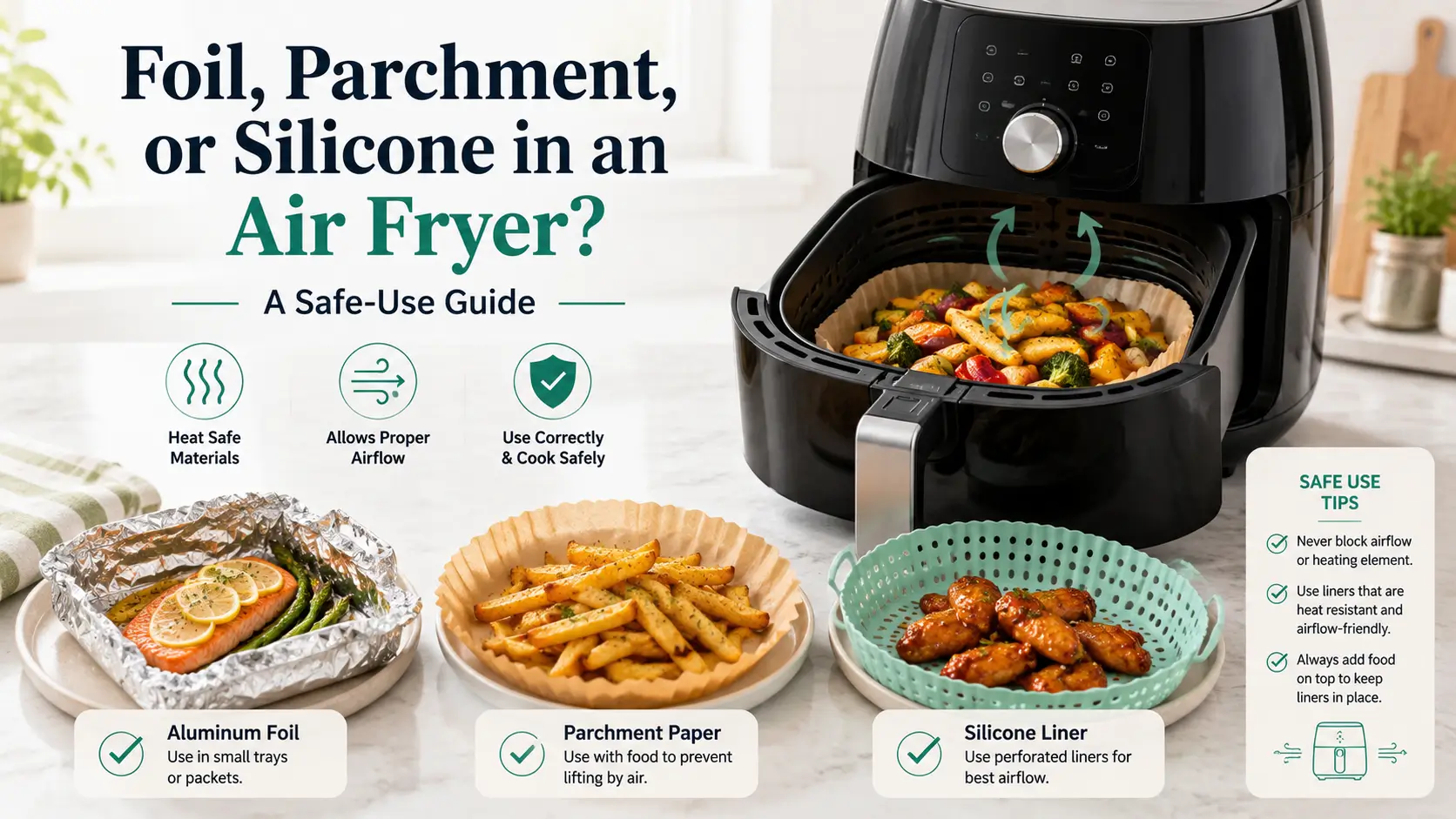
Yes, some air fryers allow aluminum foil, parchment paper or food-grade silicone accessories—but the correct answer depends on the exact brand and model. Check the owner’s manual first. If the manufacturer permits a liner, keep vents open, stay within the liner’s temperature rating and never let loose paper or foil reach the heating element.
That model-specific rule matters. Ninja permits foil and parchment in several basket-style models, while Philips says it does not recommend either in its Airfryers because they can reduce airflow or be drawn toward the heating element. Instant Pot’s general Air Fryer FAQ also says not to use foil or parchment. Your appliance manual therefore overrides any universal online answer.
If cleanup is the reason you want a liner, first see how to clean an air fryer safely without damaging its coating or electrical components.
Foil vs. parchment vs. silicone: quick comparison
| Material | Best use when permitted | Main risk | Reusable? |
| Aluminum foil | Holding or wrapping suitable foods | Blocked airflow; loose foil; acidic-food reaction | No |
| Parchment paper | Sticky or delicate foods | Loose paper can reach the heater; solid sheets reduce airflow | No |
| Food-grade silicone | Reusable baking molds or model-compatible liners | Poor fit, blocked airflow or an inadequate heat rating | Yes |
Fastest safe answer: consult the manual before choosing any material. “Oven-safe” does not automatically mean “approved for every air fryer,” because the fan, heating element and airflow path vary by design.
Can you put aluminum foil in an air fryer?
You can use aluminum foil only if the manufacturer permits it for your exact model. For example, Ninja states that foil is safe in the baskets or drawers of several models, including its AF100 and AF160 series. Philips, however, advises against foil in its Airfryers. Instant Pot’s general Air Fryer FAQ also says not to use it.
How to use foil more safely when the manual allows it
- Keep the foil inside the approved basket, drawer, tray or pan; never place it where the manual prohibits it.
- Do not cover ventilation holes or the entire airflow path.
- Secure the foil with food so the fan cannot lift it toward the heating element.
- Do not place loose foil in an empty appliance during preheating.
- Keep foil away from exposed heating elements and follow all model-specific placement instructions.
- Avoid direct contact between aluminum foil and highly acidic or salty foods when a nonreactive alternative is suitable.
Foil is most useful for a manufacturer-approved tray, a wrapped food packet or a small area that does not obstruct circulation. It is not a universal basket liner.
Can you put parchment paper in an air fryer?
Parchment paper is allowed in some air fryers but prohibited or discouraged in others. When it is permitted, use heat-rated parchment sized for the cooking surface. Perforated sheets may preserve more airflow in a basket, but perforations do not override the appliance manual.
The most important parchment rule
Never place an unsecured sheet of parchment in an empty air fryer. A powerful fan can lift lightweight paper into the heating element, where it may scorch or burn. Add parchment only as directed by the manufacturer and keep enough food on it to hold it down.
- Confirm the paper’s temperature rating exceeds the selected cooking temperature.
- Trim or choose the correct size so edges cannot curl toward the heater.
- Do not confuse parchment paper with wax paper; wax paper is not a substitute for high-heat cooking.
- Replace scorched, torn or heavily greased disposable parchment rather than reusing it.
Parchment is useful for foods that stick, crumble or need gentler release. It can also reduce cleanup, but a solid sheet may reduce browning underneath the food by changing airflow.
Can you put silicone in an air fryer?
Oven-safe, food-grade silicone molds and liners may be suitable when they fit the appliance and the manufacturer allows them. Philips, for example, says ovenproof silicone dishes or molds can be used in its Airfryer, even though it discourages foil and baking paper. That distinction is another reason not to treat every liner material the same.
How to evaluate a silicone liner or mold
- Check that it is labeled food-grade and oven-safe.
- Confirm its maximum temperature rating is above your cooking temperature.
- Choose the correct diameter and height so it does not touch the heating element or block circulation.
- Prefer a shape designed for your basket or tray rather than forcing an oversized liner into place.
- Stop using it if it warps, cracks, becomes sticky or develops a persistent odor after proper washing.
For researched product options, compare our best reusable air fryer liners. The buying guide explains the trade-offs between reusable silicone and disposable parchment.
Which air fryer liner is best?
There is no single best liner for every air fryer. The best option is the one explicitly permitted by the manufacturer, correctly sized for the appliance and appropriate for the food.
- Choose foil when the manual allows it and the food needs wrapping or a manufacturer-approved tray needs easier cleanup.
- Choose parchment when permitted for sticky or delicate food and when a disposable liner will not obstruct airflow.
- Choose silicone when the manual allows an oven-safe mold or reusable liner that fits without crowding the basket.
- Choose no liner when the manufacturer prohibits liners or maximum crispness and unrestricted airflow are the priorities.
Before buying a multipack, review the genuinely useful items in our best air fryer accessories guide so you do not pay for incompatible pieces.
Seven air fryer liner mistakes to avoid
- Assuming advice for one brand applies to every model.
- Covering the entire basket or blocking ventilation holes.
- Preheating with loose parchment or foil and no food holding it down.
- Letting a liner, mold or tall edge approach the heating element.
- Exceeding the temperature rating printed by the liner manufacturer.
- Using wax paper, paper towels, ordinary plastic or non-oven-safe containers.
- Treating a liner as a replacement for cleaning the basket and interior.
Brand guidance can be different
Manufacturer instructions are not consistent across the category:
- Philips: does not recommend baking paper or foil in its Airfryers, citing reduced airflow and the possibility of loose material reaching the heating element. Philips separately permits correctly fitting ovenproof silicone dishes or molds.
- Ninja: several model FAQs, including AF100 and AF160, say parchment and foil are safe in the basket or drawer. Placement instructions still depend on the model.
- Instant Pot: its general Air Fryer FAQ says not to use aluminum foil or parchment paper, although individual recipes and oven-style products may provide different directions. Follow the exact product documentation.
When online guidance conflicts, use the manual supplied with your model or the manufacturer’s support page identified by model number. Do not rely on a generic article—including this one—to override it.
Frequently asked questions
Can you put foil in an air fryer basket?
Only if the manufacturer permits foil in that exact basket or model. Keep airflow openings clear and secure the foil with food so it cannot move toward the heating element.
Can you put parchment paper in an air fryer?
Some models allow it and others discourage or prohibit it. If permitted, use heat-rated paper, size it correctly and never preheat with an unsecured sheet inside.
Do air fryer liners block airflow?
Solid or oversized liners can reduce airflow and may make food cook or brown less evenly. A perforated design may help, but it must still comply with the appliance manual.
Is silicone safer than parchment in an air fryer?
Silicone is heavier and reusable, so it is less likely to be lifted by the fan. It is not automatically safer, however; it still needs an adequate heat rating, correct fit and manufacturer approval.
Can I use wax paper in an air fryer?
No. Wax paper is not a substitute for parchment paper in high-heat cooking and may melt or smoke.
Can I put a glass or ceramic dish in an air fryer?
Only use an oven-safe dish that the appliance manufacturer permits and that leaves enough clearance for airflow. Avoid thermal shock and never use ordinary glass or plastic.
Should I use an air fryer liner every time?
No. Liners are optional. Cooking directly in the approved basket or tray usually preserves maximum airflow, while a liner may help with selected sticky or messy foods.
Bottom line
Can you put foil in an air fryer? Sometimes—but only when the instructions for your exact model allow it. The same model-specific rule applies to parchment and silicone. When a liner is permitted, keep it correctly sized, secured by food, below the heating element and clear of airflow openings. If the manual says no, cook directly in the approved basket or tray.
Owners of Ninja models can also use our Ninja air fryer cleaning guide for model-specific maintenance reminders after cooking.