
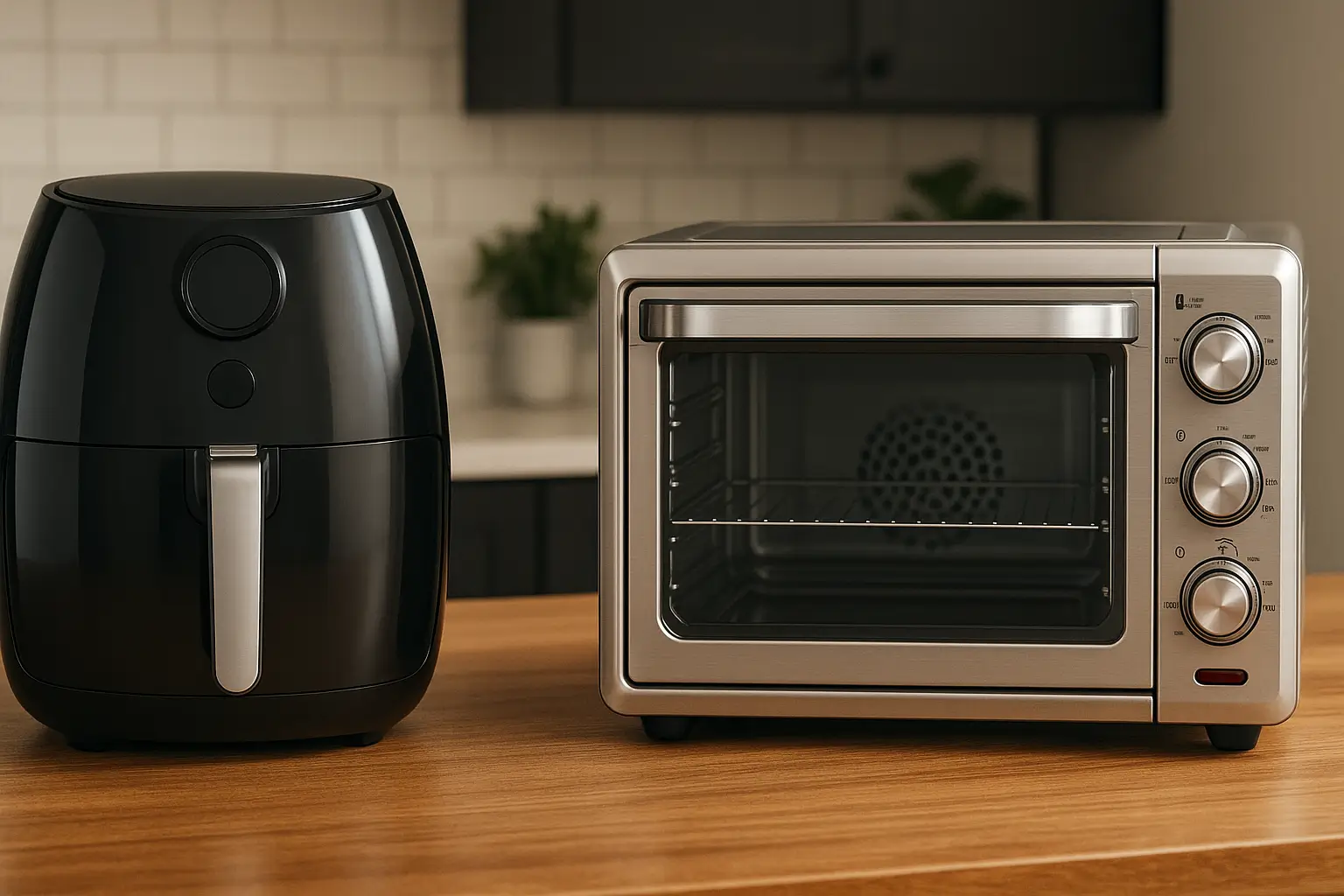
Standing in the kitchen appliances aisle at Target last month, I watched a couple debate whether to grab an air fryer or upgrade to a countertop convection oven. Their conversation probably sounds familiar—”Aren’t they basically the same thing?” “But everyone has an air fryer now…” “We already have an oven though…”
The air fryer vs convection oven debate has been heating up (pun intended) as more American households try to figure out which appliance deserves precious counter space. After spending weeks researching both options, talking to families who’ve used each, and digging through hundreds of user experiences, I’ve learned they’re more different than you might think.
Here’s the truth: while they use similar cooking technology, the choice between an air fryer and a convection oven can dramatically impact your daily cooking routine. Let me break down everything I’ve discovered to help you make the right call for your kitchen.
Understanding the Basic Technology
Before we dive into the air fryer vs convection oven comparison, let’s clear up what each appliance actually does. Both use convection cooking—circulating hot air around food to cook it quickly and evenly. That’s where the similarity ends, though.
A convection oven is essentially a regular oven with a fan and exhaust system. The fan circulates hot air throughout the cooking chamber, which is why your Thanksgiving turkey cooks faster and more evenly than in a traditional oven. Most modern ovens sold in America now include a convection setting as standard.
An air fryer, on the other hand, is specifically designed to concentrate hot air in a much smaller space with more powerful, faster circulation. Think of it as convection cooking on steroids. The rapid air movement creates that crispy, fried texture without actually submerging food in oil.
Size and Space: The Reality Check
Let’s talk about the elephant in the room—or rather, the appliance on your counter. When comparing air fryer vs convection oven, size matters way more than most people initially realize.
Air fryers typically range from 2 to 10 quarts. A standard 5-6 quart model takes up about as much counter space as a coffee maker. You can tuck it in a corner, store it in a cabinet, or leave it out without dominating your workspace. For apartment dwellers or anyone with limited counter real estate, this is huge.
Countertop convection ovens are a different story. Even compact models are roughly the size of a microwave, and larger ones can take up 2-3 feet of counter space. A woman from Seattle told me she returned her convection oven after three days because it basically eliminated her entire meal prep area. That said, if you’re replacing your microwave or toaster oven, a convection oven might fit into that existing footprint.
Built-in convection ovens solve the space issue but come with their own consideration—they’re permanent fixtures. Once installed, you’re committed. They also require professional installation in most cases, adding to the overall investment.
Cooking Capacity: How Much Can You Really Make?
The capacity question in the air fryer vs convection oven debate isn’t just about measurements—it’s about real-world cooking scenarios.
A typical 6-quart air fryer handles enough food for 2-4 people comfortably. You can cook a whole chicken (up to 5 pounds), about 2 pounds of wings, or enough fries for a family dinner. But if you’re hosting Thanksgiving or making multiple sheet pans of cookies, you’ll hit the limits quickly.
Countertop convection ovens offer significantly more space. Most can accommodate a 9×13 baking dish, multiple racks of food, or even a small turkey. One parent I connected with mentioned baking three dozen cookies at once for her daughter’s bake sale—something that would take multiple batches in an air fryer.
Here’s what came up repeatedly in my research: air fryer owners often do multiple cooking rounds for larger families or gatherings, while convection oven users appreciate the one-and-done capacity. Your household size and entertaining frequency should heavily influence this decision.
Speed and Efficiency: The Time Factor
When American families talk about why they chose one over the other in the air fryer vs convection oven discussion, speed consistently comes up.
Air fryers are ridiculously fast. Most preheat in 2-3 minutes, and the concentrated heat means cooking times are often 20-30% shorter than conventional ovens. Frozen chicken nuggets? Done in 10 minutes. Fresh salmon? 12 minutes. For busy weeknight dinners when everyone’s hungry at 6 PM, this speed advantage is real.
Convection ovens are faster than traditional ovens but slower than air fryers. Preheating takes 5-10 minutes, and while cooking times are reduced compared to standard ovens, they don’t match air fryer speed. A batch of roasted vegetables might take 25 minutes in a convection oven versus 15 minutes in an air fryer.
However, the capacity advantage of convection ovens can offset the time difference. If you’re cooking one large batch instead of three small ones, the convection oven might actually save time overall. It depends on what you’re making.
Energy Consumption: The Cost Reality
With American electricity costs varying wildly by state, the energy efficiency angle of air fryer vs convection oven deserves attention.
Air fryers typically use 1200-1500 watts. Run one for 20 minutes daily, and you’re looking at roughly $5-10 per month on your electric bill, depending on your local rates. The smaller space means less energy needed to heat and maintain temperature.
Countertop convection ovens use 1500-1800 watts, sometimes more for larger models. The bigger cooking chamber requires more energy to heat, though modern models are reasonably efficient. Still, you might see an extra $10-15 monthly if you’re using it as your primary cooking method.
A mom from Texas mentioned noticing her summer electricity bills drop after switching from her full-size oven to an air fryer for most meals. In hot climates, not heating up a large oven makes a noticeable difference in both energy costs and home cooling expenses.
Cooking Results: The Texture and Taste Test
This is where the air fryer vs convection oven comparison gets interesting, because the results genuinely differ.
Air fryers excel at creating crispy exteriors. The rapid, concentrated air circulation pulls moisture from the surface of food quickly, mimicking deep-frying results. French fries, wings, breaded items, and anything you want crunchy comes out phenomenally well. Multiple people told me their kids prefer air-fried vegetables over roasted ones because of the texture.
The downside? Air fryers can dry out food if you’re not careful. Lean proteins especially need attention, and delicate items might cook unevenly if the basket is overcrowded. There’s also a learning curve—cooking times and temperatures from traditional recipes need adjustment.
Convection ovens provide more even, gentle cooking. They’re fantastic for baking (cookies, cakes, bread all turn out great), roasting large cuts of meat, and anything that needs consistent heat distribution. The larger space means better air circulation around bigger items, preventing the hot spots that sometimes occur in air fryers.
However, convection ovens don’t achieve quite the same level of crispiness without using more oil or cooking spray. If you’re chasing that fried food texture, air fryers have the edge.
Versatility: What Can Each Actually Do?
The versatility factor in the air fryer vs convection oven debate isn’t straightforward—both are versatile, just differently.
Modern air fryers go beyond just “frying.” Many models now include settings for roasting, baking, reheating, dehydrating, and even rotisserie cooking. I’ve seen recipes for everything from cakes to hard-boiled eggs in air fryers. The limitation is scale—you can make a small cake, not a sheet cake.
Convection ovens handle nearly everything a traditional oven does, just faster and more efficiently. Baking, roasting, broiling, toasting, and reheating all work beautifully. Some models include air fry settings, attempting to bridge the gap. The pizza function on many convection ovens is legitimately excellent—something air fryers struggle with due to size.
If you’re looking to replace multiple appliances, convection ovens can often substitute for toaster ovens, traditional ovens (for smaller households), and sometimes even microwaves for reheating. Air fryers are more specialized but absolutely dominate their particular niche.
Ease of Use and Learning Curve
User-friendliness matters, especially if multiple family members will operate the appliance.
Air fryers are generally simpler. Most have straightforward controls—set temperature, set time, press start. The basket design makes loading and unloading food easy, and checking on cooking progress means just pulling out the basket. Several parents mentioned their teenagers comfortably use the air fryer unsupervised.
Convection ovens have more settings and options, which can be overwhelming initially. Rack positioning matters, different foods require different settings, and the larger space means more to manage. However, if you’re already comfortable with a traditional oven, the transition is minimal.
Cleaning and Maintenance: The Daily Reality
Let’s be honest—if it’s hard to clean, it won’t get used. The cleaning factor in air fryer vs convection oven comparisons came up constantly in user feedback.
Air fryers have removable baskets that typically go straight into the dishwasher. The non-stick coating makes hand washing quick when needed. The main unit just needs an occasional wipe-down. Total cleaning time: 2-5 minutes. The catch is that the basket and drawer can accumulate grease over time, requiring periodic deep cleaning.
Convection ovens have more surfaces to clean—racks, trays, the interior walls, and sometimes a crumb tray. Most components aren’t dishwasher safe. Spills can bake onto surfaces, requiring more elbow grease. One user described cleaning her convection oven as “mini oven cleaning every couple weeks.” Figure 10-15 minutes for thorough cleaning.
However, convection ovens contain messes better. Drips and splatters stay inside the unit, while air fryer baskets can sometimes leak through to the drawer below.
Cost Comparison: The Investment
Money talks, so let’s address the financial side of air fryer vs convection oven.
Quality air fryers run $80-200 for most home models. You’ll find budget options around $50 and premium models up to $300, but the sweet spot for reliability sits in that $100-150 range. Replacement parts (like baskets) typically cost $20-40 if needed down the road.
Countertop convection ovens span a wider range: $100-400+ depending on size and features. Basic models start around $80, but expect to spend $150-250 for something solid. High-end brands can hit $500-600.
Built-in convection ovens are a whole different category, running $800-3000+ depending on brand and features, plus installation costs.
The long-term cost consideration is durability. Quality air fryers typically last 3-5 years with regular use. Convection ovens, especially higher-end models, often last 5-10 years. When you factor in cost per year, the difference narrows.
What Real Users Wish They’d Known
Through my research, I collected insights from dozens of people who’d lived with each appliance. Here’s what came up repeatedly:
Air fryer owners said:
- “I wish I’d bought a bigger size initially—I upgraded within six months”
- “It’s amazing for quick meals but I still use my oven for baking and big gatherings”
- “The counter space it saves compared to alternatives is worth it alone”
- “My kids actually eat vegetables now that they’re crispy”
Convection oven owners said:
- “It replaced my toaster oven and half my regular oven use”
- “The capacity means I’m not constantly doing batch cooking”
- “Takes up serious counter space—make sure you have room before buying”
- “More of a learning curve than expected but worth it once you figure it out”
Who Should Choose an Air Fryer
Based on everything I’ve researched, an air fryer makes the most sense if you:
- Cook for 1-4 people regularly
- Want quick weeknight meals with minimal cleanup
- Have limited counter or storage space
- Prioritize crispy textures and fried food alternatives
- Mostly cook smaller portions or individual servings
- Value appliance simplicity and ease of use
- Want something easy for teenagers to operate safely
Air fryers particularly shine in apartment kitchens, dorm rooms, RVs, or as a supplement to existing cooking appliances. They’re also fantastic if you’re trying to eat healthier but miss fried foods.
Who Should Choose a Convection Oven
A convection oven is likely the better choice if you:
- Cook for 4+ people regularly or entertain often
- Do a lot of baking (cookies, cakes, bread)
- Want to replace multiple appliances (toaster oven, possibly main oven)
- Have adequate counter space or plan to mount/build-in
- Need versatility for different cooking styles
- Frequently prepare full meals simultaneously
- Don’t mind a bit more cleanup in exchange for capacity
Convection ovens work especially well for larger families, serious home bakers, or anyone looking to reduce reliance on their main oven (great in summer to keep the kitchen cooler).
The Best of Both Worlds Option
Here’s something that came up surprisingly often: many households eventually get both. The air fryer vs convection oven debate becomes “air fryer and convection oven” for families who fall in love with what each does best.
One strategy I heard multiple times: start with an air fryer. They’re less expensive, and you’ll quickly discover if the cooking style works for your household. If you find yourself constantly maxing out capacity or missing traditional oven cooking, then consider adding a convection oven.
Another approach is getting a hybrid—some larger convection ovens now include dedicated air fry settings. These attempt to combine both functions, though pure air fryer enthusiasts argue the results don’t quite match standalone units. Still, for space-conscious buyers, a quality convection oven with air fry capability might be the perfect compromise.
Brand Considerations for American Buyers
When you’re ready to purchase, certain brands consistently deliver quality in each category for US consumers.
Reliable air fryer brands: Cosori, Ninja, Instant Pot, and Philips get mentioned repeatedly for quality and customer service. All offer good warranty coverage and responsive support.
Solid convection oven brands: Breville, Cuisinart, KitchenAid, and Oster dominate the countertop space. For built-ins, Bosch, GE, and KitchenAid lead the pack.
Most are readily available at major retailers like Target, Walmart, Best Buy, and Amazon, often with competitive pricing and easy returns if the appliance doesn’t work out.
Making Your Final Decision
The air fryer vs convection oven choice ultimately depends on your specific kitchen needs, cooking style, and household situation. Neither is objectively “better”—they excel at different things.
Ask yourself these questions:
- How many people do I typically cook for?
- What’s my counter space situation?
- What do I cook most often?
- How important is cooking speed versus capacity?
- What’s my realistic budget?
- Do I want to replace other appliances or supplement them?
Your honest answers will point you in the right direction. And remember, this isn’t necessarily a permanent decision. You can always start with one and add the other later if your needs change.
The Bottom Line for 2025
As we move through 2025, both air fryers and convection ovens have evolved beyond their initial hype. The air fryer vs convection oven debate has matured from “which is trendy” to “which fits my actual life.”
For most American households juggling work, family, and everything in between, I’d recommend starting with an air fryer if you’re unsure. The lower investment, smaller footprint, and shorter learning curve make it an easier first step. You’ll quickly discover if the cooking style works for you, and you can always expand your appliance arsenal later.
But if you’re a baker, have a larger family, or know you need that extra capacity, don’t let trendy talk you out of a convection oven. The versatility and space are genuinely valuable for the right household.
Whatever you choose, both appliances can genuinely improve your daily cooking routine and help you spend less time in the kitchen—and that’s something every busy American family can appreciate.